


What Is A Deep Well Pump Used For?
Views: 0 Author: Site Editor Publish Time: 2026-06-23 Origin: Site


Standard surface water pumps hit a hard physical limit at 25 feet. Atmospheric pressure simply cannot push water any higher up a suction pipe. When the water table drops below this mark, relying on standard extraction methods causes rapid equipment failure. This is where the deep well pump enters the picture as the engineered solution.
We must view this equipment as more than just hardware. It represents a critical infrastructure decision for any property depending on deep aquifers for survival. A reliable water supply requires a resilient, properly configured system. If you ignore the geological realities of your property, you risk sudden water loss and expensive repairs.
Choosing the right setup means matching your specific water demands with precise physical constraints. You must calculate your required gallons per minute alongside your total dynamic head. Read on to learn how to bridge the gap between your daily water requirements and the exact physical realities of your well.
Key Takeaways
- Depth Thresholds: Required for any water table dropping below 25 feet; effectively pushes rather than pulls water to the surface.
- Core Applications: Serves high-demand residential potable water, agricultural irrigation, and heavy-duty industrial extraction.
- Selection Baseline: Procurement decisions must be based on a verified well log, Total Dynamic Head (TDH), and specific peak-demand calculations, not just horsepower.
- Risk Mitigation: Proper material selection (e.g., 304/316 stainless steel) and dry-run protection are non-negotiable for long-term ROI.
Core Applications: What Exactly Is a Deep Well Pump Used For?
You might wonder where these specialized machines actually operate. They serve diverse environments requiring reliable, high-volume water extraction from deep underground sources. Let us explore the primary applications driving their use across different sectors.
Residential Off-Grid & Rural Water Supply
Many rural homes sit far beyond the reach of municipal water lines. These properties rely entirely on private wells to supply their daily drinking, cooking, and bathing water. A standard surface unit cannot reach the deep, uncontaminated aquifers often found 100 to 300 feet below ground. You need specialized extraction equipment to lift this potable water efficiently. It provides the steady pressure required for modern household plumbing fixtures, ensuring off-grid families enjoy the same water consistency as city dwellers.
Agricultural Irrigation
Farms and ranches demand massive volumes of water daily. Crops require consistent hydration, and livestock need reliable drinking troughs. Agricultural operators use multistage submersible designs built for sustained duty cycles. These machines run continuously for hours without overheating. They deliver high-volume water delivery across expansive irrigation networks. Without them, maintaining commercial crop yields or supporting large herds in arid regions would be physically impossible.
Industrial & Commercial Extraction
Heavy industries rely heavily on robust groundwater extraction. Mining operations use them for dewatering deep shafts. Municipalities use them to boost city water reserves from underground reservoirs. Manufacturing facilities often require significant water volumes for cooling machinery or processing materials. These environments demand high head pressure and exceptional chemical or corrosion resistance. Manufacturers often specify upgraded alloys and heavy-duty motors to handle these brutal, continuous operational demands.
Geothermal Heat Pump Systems
Modern high-efficiency HVAC systems often utilize groundwater to heat and cool buildings. Open-loop geothermal systems extract water from an aquifer, pass it through a heat exchanger, and return it to the earth. This process requires highly stable flow rates to maintain thermal efficiency. The extraction equipment must deliver a constant, precise volume of water regardless of seasonal groundwater fluctuations. It ensures the heat pump operates at peak performance year-round.
The Decision Boundary: Deep Well vs. Shallow Well Pumps
How do you know if you actually need this specific product category? The answer lies in physics and the exact measurements of your water source. Understanding these boundaries prevents costly purchasing mistakes.
The 25-Foot Physics Limit
Standard shallow well jet pumps sit above ground and pull water up through a suction pipe. However, they rely on atmospheric pressure to do the heavy lifting. Physics dictates a strict limit here. Once the water level drops past 25 feet, atmospheric pressure cannot overcome the weight of the water column. The system begins to experience cavitation. Water vaporizes inside the line, suction breaks, and the motor spins uselessly. If your water sits deeper than 25 feet, you must utilize specialized deep-extraction equipment.
Static vs. Dynamic Water Levels
Many buyers make the mistake of sizing their equipment based on the static water level. This is where the water rests when no extraction occurs. However, you must evaluate the dynamic water level, also known as the drawdown level. When you turn on the system, the water level inside the casing drops as the reservoir depletes. During dry seasons, this drawdown can drop significantly lower than the static line. You must size your equipment based on this lowest potential dynamic level to prevent catastrophic dry-running.
Push vs. Pull Mechanics
The fundamental mechanical difference comes down to pushing versus pulling. Surface models pull water, fighting atmospheric limits and gravity simultaneously. Submersibles sit below the waterline and push the fluid upward. Pushing water requires significantly less energy and bypasses the 25-foot suction limitation entirely. This push mechanic is inherently more efficient. It allows you to move higher volumes of fluid over much greater vertical distances using less electricity.
| Feature | Shallow Well Jet Pump | Deep Well Submersible Pump |
|---|---|---|
| Maximum Depth | 25 feet | 400+ feet |
| Mechanical Action | Pulls water (Suction) | Pushes water (Direct Drive) |
| Installation Location | Above ground | Fully submerged underground |
| Efficiency | Lower | Significantly Higher |
Types of Deep Well Pumps and Their Use Cases
Once you cross the 25-foot threshold, you encounter two primary architectural designs. Each solution category serves specific depths and maintenance preferences.
Deep Well Submersible Pumps
This design represents the gold standard for deep extraction. You install it entirely underwater, dropping it directly into the casing.
- Mechanism: It utilizes stacked, multistage impellers housed within a cylindrical body. As the motor spins, water enters the bottom screen. Each successive impeller boosts the water pressure, effectively pushing the fluid up the main drop pipe.
- Best for: Depths extending up to 400 feet or more. Because they sit underwater, they never lose prime. They maximize energy efficiency and operate silently, completely eliminating surface motor noise.
- Material Considerations: Industrial specs often require specialized materials. Standard cast iron easily rusts in harsh groundwater. You should look for 304 or 316 stainless steel housings. These premium alloys prevent long-term galvanic corrosion, ensuring the unit survives decades submerged in mineral-heavy water.
Deep Well Jet Pumps
Not every property owner wants to pull 100 feet of pipe out of the ground to service a motor. Jet models offer a compromise between depth capability and surface accessibility.
- Mechanism: The motor remains safely mounted above ground. It utilizes a dual-pipe system consisting of a suction line and a drive line. The system pushes some water down the drive line into an ejector assembly lowered into the casing. The venturi effect created by this ejector forces additional water up the suction line.
- Best for: Depths between 25 and 110 feet. You sacrifice maximum energy efficiency for unparalleled access. If a motor part fails, you can easily repair the surface unit without hiring a heavy-duty crane or specialized puller rig.
Evaluation Criteria: Sizing and Selecting the Right System
You cannot simply buy the largest motor available and hope it works. Proper selection requires objective mathematical frameworks. You must map specific hardware features to your desired outcomes.
Calculating Peak Demand (GPM)
Your first task involves auditing your household or agricultural fixtures to determine the required Gallons Per Minute (GPM). If multiple people use water simultaneously, your system must keep up. A simple rule of thumb suggests allocating 1 GPM for every water fixture in the home. If you have two bathrooms, a kitchen sink, a dishwasher, and a washing machine, you need a unit capable of delivering at least 8 to 10 GPM during peak morning hours. Agricultural setups require a much stricter audit of irrigation head flow rates.
Understanding Total Dynamic Head (TDH)
Peak demand only tells half the story. You must calculate the Total Dynamic Head. This critical equation represents the total resistance the equipment must overcome. It combines three factors: vertical lift (the distance from the drawdown level to the surface), friction loss (the resistance caused by water rubbing against the inside of the pipes), and required service pressure (typically 40 to 60 PSI for a standard pressure tank). Failing to calculate TDH accurately guarantees poor system performance.
Reading Performance Curves
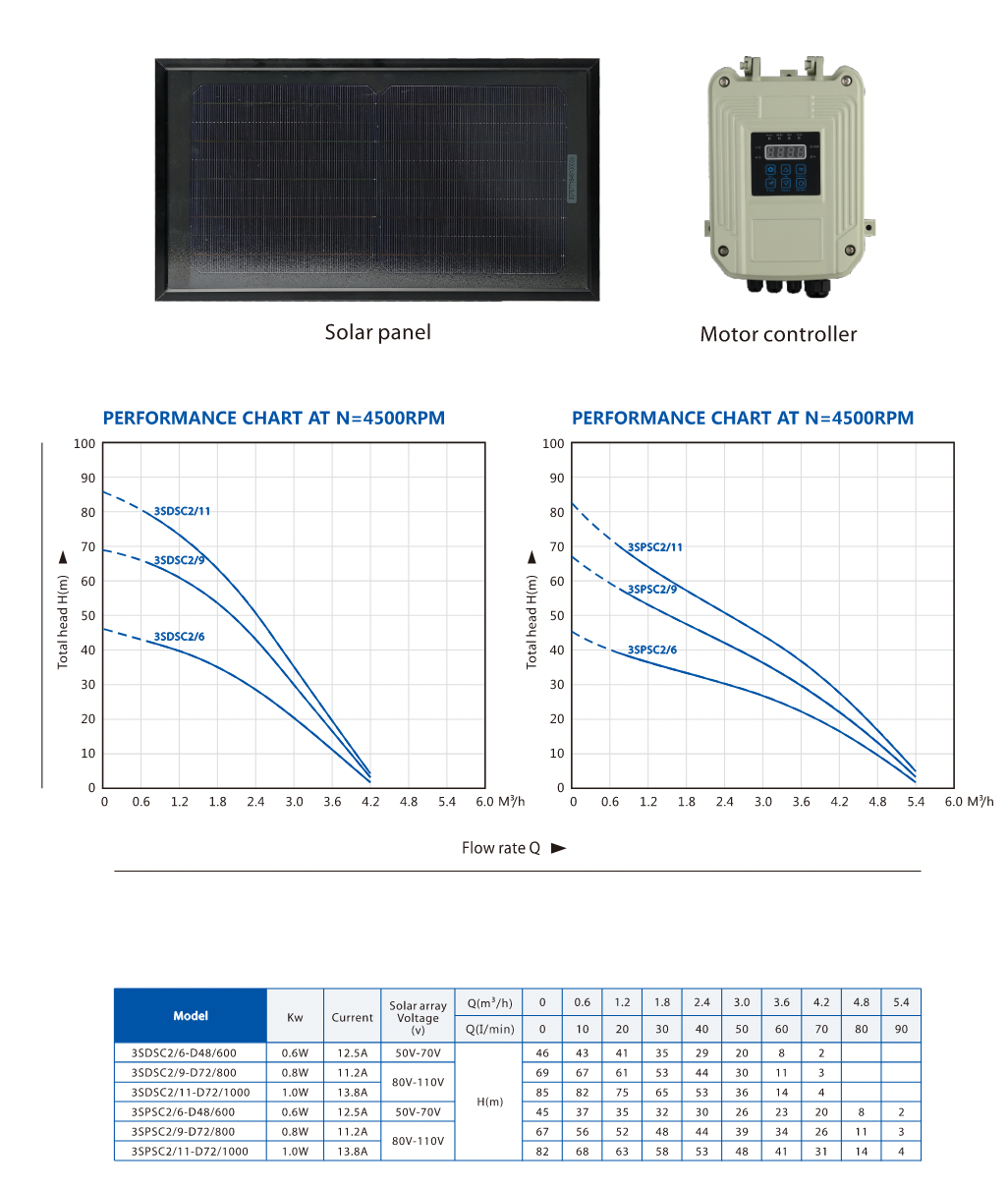
Never buy based solely on maximum horsepower (HP). Manufacturers provide performance curves to map exact capabilities. These charts plot TDH against GPM. You must evaluate the unit's efficiency at your specific operating point. Find your calculated TDH on the vertical axis and draw a line to the curve. Drop down to the horizontal axis to see the exact GPM it will deliver. If your operating point falls too far to the left or right of the curve's center "efficiency island," you will drastically shorten the motor's lifespan.
Motor Configuration
When selecting a submersible, you must choose between 2-wire and 3-wire motor setups. A 2-wire motor houses its starting capacitor internally, right alongside the motor. A 3-wire setup keeps the starting capacitor inside a control box mounted above ground. The 3-wire configuration offers easier maintenance. Starting capacitors fail frequently. If you use a 3-wire system, you can swap the surface capacitor in five minutes. If you use a 2-wire system, you must pull the entire unit out of the ground to fix a basic electrical failure.
Implementation Risks and Operational Longevity
Even the best deep well pump will fail if installed incorrectly. You must understand the rollout realities and environmental hazards hidden underground.
Sand Abrasion and Silt Mitigation
Groundwater is rarely perfectly clean. Suspended solids act like liquid sandpaper. If your aquifer contains high sand levels, it will quickly destroy standard thermoplastic impellers. The abrasive action carves grooves into the plastic, destroying the tight tolerances required to build pressure. If your well log indicates high sediment, you must specify specialized sand-handling pump ends. These utilize floating impeller designs or specialized brass components to pass grit without catastrophic scoring.
Dry-Running Hazards
Water cools the submerged motor. If the aquifer depletes and the water level drops below the intake screen, the motor runs dry. Within minutes, the internal components overheat and melt. This dry-running hazard destroys expensive equipment instantly. You must install low-yield protection. Modern control boxes use electronic load sensors. If the amperage drops—indicating the motor is spinning freely in air—the protector immediately shuts the system down until the water table recovers.
Installation Realities
Torque forces during startup are violent. Every time the motor kicks on, the entire unit twists inside the casing. If it rubs against the steel walls, the friction will eventually chafe through the wire insulation, causing a dead short. You must install rubber torque arrestors to absorb this shock. Additionally, you must select the correct drop pipe. Shallow installations can use flexible poly pipe. Deep installations exceeding 200 feet demand rigid Schedule 80 PVC threaded drop pipes to safely support the massive weight of the suspended water column.
Shortlisting Logic: Next Steps for Procurement
Ready to move forward? Follow this strict shortlisting logic to drive qualified action and procure the exact right equipment for your property.
- Obtain the Well Log: Never guess your depth. Contact the driller who originally sank the shaft. Secure their official driller’s report. This document confirms the casing diameter, the total depth, the static water level, and the safe yield (how fast the aquifer replenishes itself). You cannot accurately size a system without this foundational data.
- Match Power Supply: Verify your available electrical infrastructure. Consumer setups typically utilize single-phase 230V power. Smaller cabins might only offer 115V. Heavy commercial facilities often provide three-phase power. Matching your motor phase and voltage to your breaker panel is a non-negotiable first step.
- Consult Sizing Charts: Take your calculated TDH and GPM numbers. Cross-reference them with the manufacturer specification sheets. Look closely at the performance curves. Ensure the unit operates efficiently at your specific depth. If the math feels overwhelming, consult the manufacturer's technical support desk before finalizing any purchase.
Conclusion
Securing a reliable water supply from deep underground requires a precise, mathematical approach. A deep well pump stands as a critical investment strictly governed by the physical parameters of your specific site. You cannot alter the depth of your aquifer or the laws of atmospheric pressure. You can only adapt by selecting the correct multistage equipment designed to push water effectively from the depths.
Remember, over-sizing your equipment proves just as detrimental as under-sizing it. Too much horsepower leads to rapid cycling, hammering your pipes and causing premature motor failure. Too little horsepower leaves you with sputtering faucets and failing irrigation zones.
Take action today by gathering your concrete data. Locate your official well log. Calculate your household's peak gallon-per-minute demand. Consult a specific sizing calculator or review detailed technical specification sheets. If your property features extreme depths or complex friction losses, contact a specialized well technician to verify your total dynamic head calculations before placing your order.
FAQ
Q: What is the maximum depth a deep well pump can handle?
A: Depth capabilities depend heavily on the specific model and sector. Consumer-grade submersibles typically extract water efficiently from depths up to 400 feet. Heavy-duty industrial multistage models can exceed 1,000 feet by adding dozens of stacked impellers and upgrading to high-horsepower motors. Surface jet models max out around 110 feet.
Q: How long does a deep well submersible pump last?
A: When sized and installed correctly, a quality submersible averages 10 to 15 years of reliable service. However, this lifespan heavily depends on environmental factors. High sediment levels, frequent dry-running, or rapid cycling from a waterlogged pressure tank can destroy the motor in less than three years.
Q: Can I run a deep well pump on solar power?
A: Yes. Many off-grid setups utilize specialized DC-powered submersibles designed to run directly from solar panels. If you use a standard AC motor, you must install a highly efficient soft-start inverter. This device manages the massive electrical surge required during the initial motor startup phase.
Q: Why is my deep well pump running continuously?
A: Continuous running indicates the system cannot reach its designated shut-off pressure. Common causes include a ruptured bladder inside the pressure tank, a significant leak somewhere in the underground drop pipe, or severely worn impellers. When impellers wear down from sand abrasion, they lose the ability to build sufficient pressure.


