


What Is The Best Pump For A Deep Well?
Views: 0 Author: Site Editor Publish Time: 2026-06-25 Origin: Site


Replacing or installing a water system requires careful planning and precise calculations. Undersizing your equipment leads to frustratingly poor water pressure during morning routines. Conversely, oversizing causes rapid short-cycling. This frequent on-and-off action guarantees premature motor failure. The optimal solution is rarely just a popular brand name. Instead, you need a unit perfectly tailored to your unique property conditions. We evaluate your static water level, well recovery rate, and peak household flow demand.
This guide breaks down the essential evaluation criteria. We focus strictly on technical specifications rather than flashy marketing claims. You will learn exactly how to calculate your daily water needs mathematically. We also cover critical system components for residential, rural, and off-grid applications. Properly sizing your equipment ensures reliable water delivery. You can confidently build a robust water system and secure steady access for years to come.
Key Takeaways
- Depth Dictates Technology: Wells deeper than 25 feet require either a deep well jet pump or a submersible pump. Submersibles are the undisputed standard for depths exceeding 100 feet.
- Sizing is a Mathematical Formula: Purchasing decisions must be based on Total Dynamic Head (TDH) and required Gallons Per Minute (GPM), not guesswork.
- Power Configuration Matters: The choice between 2-wire and 3-wire configurations dictates where your starting components live—affecting both installation complexity and future maintenance costs.
- The Pump is Only One Component: Long-term reliability relies on a properly sized pressure tank and system accessories (check valves, controllers) to prevent motor burnout.
The Evaluation Framework: How to Properly Size a Deep Well Pump
Selecting the right equipment requires concrete mathematical formulas. You cannot guess your water requirements. You must base your decision on peak demand, dynamic head, and exact horsepower limits. A correctly sized deep well pump protects your plumbing infrastructure and maximizes motor longevity.
Calculating Peak Demand (GPM)
You must first determine your household's peak water demand in Gallons Per Minute (GPM). Industry professionals use a reliable rule of thumb for this metric. You simply count the water fixtures in the home. Include all sinks, showers, toilets, washing machines, and outdoor spigots. Each fixture generally equals 1 GPM of required flow. A home boasting three bathrooms and a large kitchen typically requires roughly 12 to 14 GPM during busy mornings.
However, you face a critical constraint. Your equipment's GPM output must never exceed the natural recovery rate of your aquifer. Hydrogeologists call this the well yield. Pumping faster than the aquifer replenishes will drain the casing completely dry. This severe error induces dry-running. Dry-running melts plastic impellers and quickly burns out the electric motor.
Determining Total Dynamic Head (TDH)
Total physical depth alone remains insufficient for proper sizing. Total Dynamic Head (TDH) measures the absolute total resistance the motor must overcome. TDH calculates the vertical distance down to the static water level. You then add the vertical lift from the wellhead up to the highest fixture in the house. Finally, you convert your desired system pressure into feet of head. Typically, 1 PSI equals 2.31 feet of vertical lift.
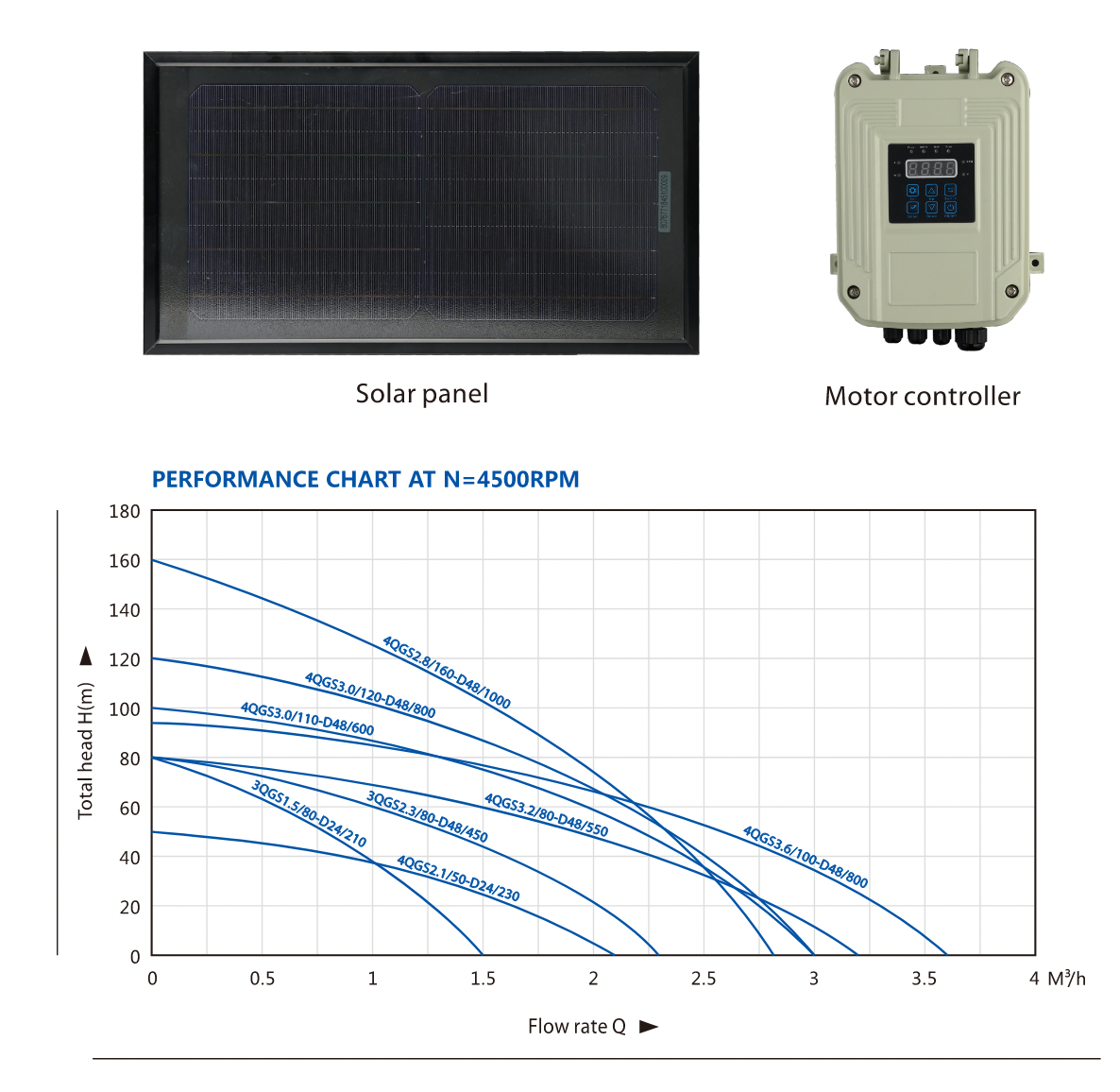
Once you calculate your total TDH, you compare it against manufacturer performance curves. These graphical charts plot TDH against GPM. You locate your TDH on the vertical axis. You follow the line across to find a unit delivering your required GPM at that specific head pressure.
Selecting Horsepower (HP)
Many homeowners fall victim to the "bigger is better" fallacy. They purchase the largest motor available. An oversized motor wastes electrical energy and repeatedly slams check valves shut. We strictly rely on baseline ranges tailored to physical depth.
| Well Depth Range | Recommended Horsepower (HP) | Typical Application |
|---|---|---|
| Up to 100 feet | ½ HP | Shallow to moderate depths, standard residential use. |
| 100 to 250 feet | ¾ HP to 1 HP | Average deep installations, higher household demand. |
| 300 to 500+ feet | 1.5 HP to 5+ HP | Extreme depths, agricultural use, long vertical lifts. |
Deep Well Submersible vs. Jet Pumps: Capability and Limits
You generally choose between two primary technologies for deeper installations. You can select an above-ground jet system or a fully submerged unit. Each technology serves specific depth ranges and operational needs.
Deep Well Jet Pumps (Above Ground)
Above-ground jet units utilize a complex two-pipe system. They push water down the drive pipe through a restrictive ejector assembly lowered into the casing. This restriction creates a powerful vacuum. The vacuum naturally draws groundwater up the second suction pipe. These units remain perfectly viable for depths spanning between 25 and 110 feet.
Despite their accessibility, they suffer from notable drawbacks. They become highly inefficient at greater depths because pushing water down to pull water up wastes massive amounts of energy. They frequently lose prime if a tiny leak develops in the suction line. Furthermore, housing the motor above ground generates considerable noise near the residence.
Submersible Pumps (Below Ground)
Below-ground units operate on a much simpler physical principle. They sit entirely submerged in the aquifer. They push water upward from the bottom rather than pulling it. Pushing water requires significantly less energy. Consequently, submersibles represent the definitive choice for depths ranging from 100 to 500 feet and beyond.
They offer tremendous operational advantages. The units are completely self-priming because they sit underwater. Operation remains entirely silent above ground. Constant submersion in cool groundwater actively dissipates motor heat. This continuous natural cooling dramatically extends their average lifespan. Most high-quality units easily last 10 to 15 years before requiring replacement.
| Feature | Deep Well Jet Pumps | Submersible Pumps |
|---|---|---|
| Installation Location | Above ground (basement or pump house) | Below ground (submerged in water) |
| Effective Depth Limit | Up to 110 feet | 100 to over 500 feet |
| Efficiency | Moderate (wastes energy pushing water down) | Extremely high (pushes water directly up) |
| Noise Level | Loud (motor runs above ground) | Completely silent |
Power Configurations: 2-Wire vs. 3-Wire Systems
Once you select a below-ground unit, you face another crucial technical decision. You must choose the internal electrical configuration. Submersible motors require a starting capacitor to initiate rotation. The placement of this capacitor dictates whether you purchase a 2-wire or a 3-wire system.
2-Wire Pumps (Simpler Installation)
A 2-wire system features a highly streamlined design. The drop cable contains two power wires plus one green ground wire. Manufacturers build the starting capacitor and sensitive starting controls directly inside the sealed motor housing deep underground.
This streamlined approach offers clear pros. You enjoy a simpler, faster upfront installation. You run fewer wires down the casing. You also avoid mounting any electrical control boxes on your interior walls. However, the cons are significant. Starting capacitors represent the most common point of electrical failure. If the internal capacitor fails, you must hire a rig to pull the entire deep well pump out of the ground just to replace a tiny component.
3-Wire Pumps (Easier Maintenance)
A 3-wire system separates the starting components from the motor housing. The drop cable contains three power wires plus one ground wire. The starting capacitor and relay live inside a dedicated control box mounted securely above ground.
This separation provides massive long-term pros. You can troubleshoot and replace the most common failure points standing safely in your basement or pump house. You never need an expensive pump hoist to fix a blown capacitor. The cons include a slightly more complex installation process. You must wire the external control box correctly. You also need slightly heavier 4-conductor drop wire reaching down the casing.
Off-Grid and Solar Deep Well Pump Considerations
Rural properties and remote cabins present unique electrical challenges. Standard municipal grid power provides unlimited amperage to start heavy machinery. Off-grid systems rely on limited battery banks and sensitive inverters. You must select equipment capable of operating within these tight electrical constraints.
The Rural/Off-Grid Challenge
Traditional alternating current (AC) motors require massive starting surges. Engineers call this the inrush current. A standard 1 HP motor might draw 8 amps while running but demand 35 amps for a split second during startup. This aggressive surge easily overloads standard off-grid solar inverters. The inverter will instantly shut down to protect its internal circuitry, leaving you without water.
DC Solar Pumps
Direct current (DC) solar units eliminate the AC surge problem entirely. These units feature highly efficient brushless DC motors. They include built-in Maximum Power Point Tracking (MPPT) controllers. The MPPT controller optimizes the voltage coming directly from your solar array. DC units remain ideal for depths up to 300 feet. They happily run directly off solar panels without requiring massive battery banks or complex inverters.
Soft-Start Technology
Many off-grid users still prefer running standard AC equipment due to higher flow rates. In these scenarios, a variable frequency drive (VFD) or soft-starter becomes absolutely critical. A soft-starter gradually ramps up the motor voltage over several seconds. This gentle acceleration completely eliminates the aggressive power surge. You securely protect your expensive inverter and preserve the lifespan of your battery bank.
Implementation Realities and System Dependencies
Purchasing an excellent motor only solves half the equation. You must install the equipment using the correct supporting infrastructure. Ignoring fundamental electrical and plumbing rules will destroy the best equipment on the market.
The Perils of Long Wire Runs
Deep installations reaching 300 to 500 feet suffer from significant electrical resistance. Long stretches of copper wire cause noticeable voltage drop. If you send 230 volts down the casing, the motor might only receive 205 volts at the bottom. Failing to upsize the wire gauge causes immediate disaster. You must frequently upgrade from 12 AWG to thicker 10 AWG or 8 AWG wire. Starving the motor of voltage causes severe overheating and instantly voids manufacturer warranties.
Pressure Tank Matching
A high-quality deep well pump requires a strict minimum runtime to survive. The unit must run for at least one to two minutes per cycle. This duration ensures cool groundwater flows over the motor housing long enough to dissipate accumulated heat. Your pressure tank's drawdown capacity enforces this runtime. If you install a tiny pressure tank, the motor will cycle on and off every ten seconds. You must properly size the tank to guarantee the required minimum runtime.
Essential Accessories
You should never install subterranean equipment without mandatory protective accessories. We strongly recommend including the following items:
- Torque Arrestors: Motors twist violently when they kick on. Torque arrestors fit snugly around the drop pipe. They prevent the equipment from violently chafing against the steel casing.
- Multiple Check Valves: You need a primary check valve on the unit itself and secondary valves every 100 feet up the drop pipe. They carry the weight of the water column and prevent devastating water hammer effects.
- Dry-Run Protection Switches: These smart switches monitor electrical amperage. If the aquifer runs dry, the motor amperage drops. The switch instantly cuts power to prevent the plastic impellers from melting together.
Conclusion
Selecting the right equipment requires systematic evaluation rather than guesswork. You secure long-term reliability by meticulously matching the equipment to your property's physical realities. Follow these clear shortlisting steps:
- Verify your exact static water level and the natural recovery yield of the aquifer.
- Calculate your household GPM demand and your total TDH mathematically.
- Examine manufacturer performance curves to find the precise horsepower required.
- Choose a 3-wire configuration for easier long-term maintenance, or select a DC solar unit for off-grid properties.
Consult with a certified driller or professional hydrogeologist if you remain unsure about your specific flow rate. Professional verification prevents costly mistakes before you purchase system components.
FAQ
Q: How long should a deep well pump last?
A: High-quality submersibles typically last 10 to 15 years. Their lifespan depends heavily on proper sizing, good water quality, and the complete elimination of short-cycling. Units installed in sediment-heavy water or paired with undersized pressure tanks may fail in under five years due to abrasion and overheating.
Q: Can a deep well pump be too big for a well?
A: Yes. Oversizing represents a severe hazard. If the unit pumps faster than the aquifer recovers, it will drain the casing dry. This causes cavitation and aggressive dry-running. The lack of cooling water rapidly melts the impellers and completely burns out the motor.
Q: What is the difference between a 115V and 230V well pump?
A: The primary difference lies in amperage draw. A 230V motor draws half the amps of a 115V motor to produce the same horsepower. Lower amperage allows you to use thinner, more manageable drop wire. Industry standards require 230V for anything exceeding ½ HP.
Q: Do I need a Constant Pressure System (VFD)?
A: You do not strictly need one, but they provide excellent benefits. A Variable Frequency Drive (VFD) speeds up or slows down the motor to match your real-time water usage. This technology eliminates pressure fluctuations, giving rural homes smooth, "city-like" water pressure during heavy demand.


