


How Can Solar Deep Well Pumps Support Off-Grid Farm Irrigation?
Views: 0 Author: Site Editor Publish Time: 2026-11-21 Origin: Site


Securing a reliable, high-volume water supply for remote fields challenges farmers everywhere. You face an uphill battle when municipal grids remain completely out of reach. Sourcing affordable continuous power proves difficult in isolated agricultural zones. Traditional farming operations rely heavily on expensive, maintenance-heavy diesel generators. These loud machines drain budgets through constant fuel consumption and sudden mechanical repairs. Modern solar pumping technology completely changes this frustrating dynamic. They utilize free sunlight to move water efficiently across vast distances.
This guide provides a clear, evidence-based framework for evaluating, sizing, and implementing agricultural water solutions. You will learn exactly how to design a sustainable setup tailored for farm use. We explore practical steps to deploy a Deep Well Pump powered entirely by renewable energy. Readers will discover methods to calculate exact water needs, avoid common installation pitfalls, and select durable equipment.
Key Takeaways
A solar deep well pump trades higher upfront capital expenditure (CAPEX) for near-zero operational expenditure (OPEX), delivering long-term ROI for remote farms.
System viability depends heavily on accurately calculating Total Dynamic Head (TDH) and daily flow requirements against local solar irradiance data.
Effective off-grid irrigation requires matching the solar submersible pump to the specific pressure demands of the distribution method (e.g., drip lines vs. flood irrigation).
Mitigating implementation risks requires prioritizing water storage (tanks) over battery storage to manage cloudy days and nighttime watering needs efficiently.
The Business Case: Framing the Off-Grid Water Challenge
Evaluate the hidden costs hiding behind diesel-powered irrigation. Fuel transport logistics consume valuable hours every single week. Farm workers drive heavy trucks across rugged dirt roads simply to refuel remote tanks. Price volatility wreaks havoc on seasonal financial planning. Fuel prices spike unpredictably during critical harvest seasons. Frequent mechanical maintenance causes sudden downtime. Generators drop offline exactly when crops need moisture most.
Acknowledge the prohibitive costs blocking utility line extensions. Running power cables to remote agricultural acreage demands massive capital. Utility companies often quote tens of thousands of dollars per mile. Many farmers abandon fertile land simply because grid access remains impossible.
Define the transformational nature of the solar shift. Transitioning to a Solar Deep Well Pump revolutionizes water access. You change a recurring variable cost into a fixed, depreciable asset. Sunlight arrives freely every morning. Your equipment runs quietly without ongoing fuel purchases.
Establish clear success criteria for your project. A successful implementation must deliver consistent daily water volumes. It must integrate seamlessly into your existing irrigation infrastructure. We expect minimal seasonal intervention from operators. The system should operate autonomously throughout the growing season.
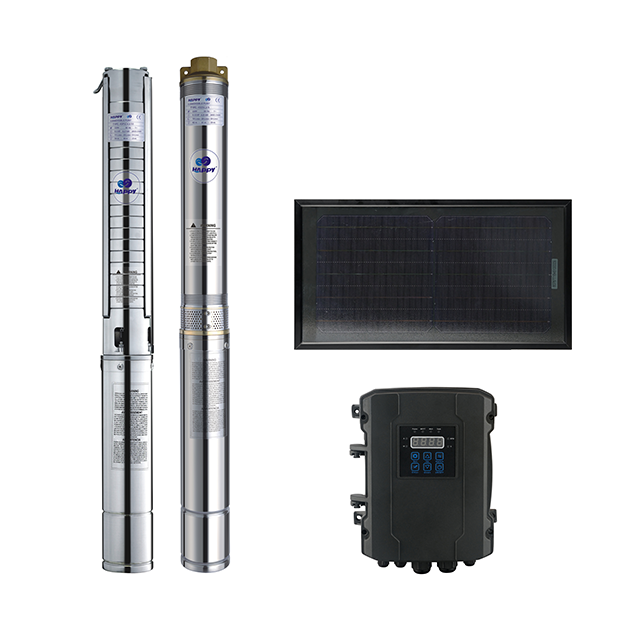
Core Capabilities of a Solar Submersible Pump
Briefly detail the mechanics behind deep extraction. These specialized machines push water upward from deep underground aquifers. They easily handle depths ranging from 100 to over 500 feet. Highly efficient DC brushless motors drive the internal impellers. These advanced motors eliminate internal mechanical friction. They convert weak morning sunlight into immediate rotational force.
Explain the standard agricultural configuration. Solar panels power the equipment directly during daylight. We call this a direct-drive configuration. It proves generally more reliable than complex battery-backed systems. Farm environments destroy lead-acid or lithium batteries quickly. Extreme heat and cold degrade chemical storage capacity within months. Direct-drive setups bypass this vulnerability entirely.
Understand integration rules for different irrigation types:
Drip Irrigation: A Solar Submersible Pump provides steady, low-pressure flow. This profile matches perfectly for sustainable watering. Drip lines deliver moisture directly to plant roots. Minimal evaporation occurs during the delivery process.
High-Pressure Systems: Pivot or sprinkler systems demand immense line pressure. Operating them off-grid exposes distinct limitations. You must implement necessary workarounds to achieve success. Farms often install booster pumps near the field edge. Alternatively, they build elevated gravity tanks to generate adequate PSI artificially.
Evaluation Dimensions: Specifying Your Off-Grid Irrigation Pump
How do you calculate the true distance water travels? Industry professionals use Total Dynamic Head (TDH) to measure this resistance. You add the static water level to the seasonal drawdown figure. Next, you calculate friction loss inside the delivery pipe. Finally, you add the above-ground elevation to the final destination.
Understanding Total Dynamic Head (TDH) Variables
TDH Variable | Definition | Impact on Pump Sizing |
|---|---|---|
Static Water Level | Distance from the ground surface to the resting water line. | Establishes the absolute minimum lifting baseline. |
Drawdown | The distance water drops while active pumping occurs. | Requires sizing the motor for the lowest expected dynamic water level. |
Friction Loss | Resistance created by water rubbing against pipe walls. | Dictates pipe diameter choices to reduce energy waste. |
Elevation | Vertical distance from the wellhead to the storage tank. | Adds direct gravity resistance to the final calculation. |
Move away from measuring "gallons per minute." Shift your focus toward "gallons per day." Solar power fluctuates constantly as clouds pass overhead. A daily target provides a much clearer metric for success. Factor in peak crop water demand during the hottest, driest months. Always size your equipment for August heat rather than April showers.
Read manufacturer charts meticulously to ensure peak efficiency. These pump performance curves reveal exact operational limits. Find where your specific TDH intersects your required flow rate. Make sure the equipment operates properly within the farm's specific solar window. Do not confuse total daylight hours for peak sun hours. Only calculate performance using hours of intense, direct irradiance.
Evaluate material durability thoroughly. Agricultural wells frequently contain abrasive sand and sharp silt. These particles destroy cheap plastic impellers quickly. Demand heavy-duty stainless steel construction. Look for specialized impellers designed specifically to resist abrasion. Superior materials prevent costly mid-season breakdowns.
Implementation Realities and Installation Risks
Address the primary limitation of renewable energy. Intermittency poses a massive risk to delicate crops. Clouds roll in unexpectedly. The sun sets every single evening. Solve this by implementing high-capacity water storage tanks. Treat water tanks as your primary energy battery. Store potential energy as elevated water rather than chemical electricity. Avoid buying expensive, consumable battery banks whenever possible.
Ensure the chosen equipment fits securely inside existing boreholes. We call these well casing constraints. The physical diameter must leave adequate clearance around the motor. Tight fits restrict crucial motor cooling flow. Moving water absorbs heat generated by the spinning motor. If water cannot flow past the housing, the unit overheats instantly.
Install mandatory dry-run and voltage protection. Built-in sensors prevent catastrophic motor burnout. Seasonal aquifer drawdowns leave pumps spinning in dry air. A dry-run sensor shuts the system down immediately. Partial panel shading causes dangerous voltage drops. Advanced controllers monitor incoming power constantly. They pause operation until sunlight returns to safe threshold levels.
Establish practical protocols for winterization and seasonal maintenance. Hard freezes destroy PVC pipes and crack metal valves. Follow these steps in regions experiencing severe winter weather:
Disconnect all above-ground delivery pipes from the main wellhead.
Open drainage valves to empty residual water from exposed manifolds.
Secure all solar panels tightly to withstand high winter winds.
Seal the main control box to protect delicate electronics from condensation.
Shortlisting and Sizing: Next Steps for Procurement
Conduct a rigorous water audit before spending money. Accurate, verifiable data prevents expensive purchasing mistakes. Quantify your exact crop needs per acre. Hire a local driller to test your well recovery rates. A well producing only ten gallons per minute cannot sustain a massive fifty-gallon pump. Gather this vital data before contacting any suppliers.
Evaluate potential vendors carefully. What should you look for in a manufacturer? Seek out companies offering comprehensive sizing software. They should generate custom performance reports for your specific GPS coordinates. Confirm they keep replacement parts readily available in domestic warehouses. Localized technical support saves crops when emergency troubleshooting becomes necessary.
Check standard warranties on motors and photovoltaic arrays. Reliable manufacturers often provide one or two years of coverage on motors. Solar panels usually carry performance guarantees up to 25 years. Ensure your entire system meets local agricultural water extraction regulations. A quality Off-Grid Irrigation Pump supplier helps navigate regional compliance requirements smoothly. They understand municipal restrictions regarding maximum daily aquifer withdrawals.
Conclusion
A well-calibrated setup eliminates frustrating fuel dependency. It completely removes operational bottlenecks for remote farms. You regain control over your seasonal watering schedules. Your operating margins improve drastically once diesel expenses vanish from the ledger.
Success hinges entirely on precise initial sizing. You must calculate dynamic head and daily flow rates accurately. A storage-first approach to water management guarantees long-term reliability. Tanks bridge the gap during cloudy days and quiet nights.
Take immediate action today. Gather your exact well depth measurements. Calculate your peak daily water requirements. Document your precise farm location data. Use this information to begin a custom system sizing consultation. Expert guidance ensures your investment yields abundant harvests for decades.
FAQ
Q: Can a solar deep well pump run at night or on cloudy days?
A: Direct-drive systems cannot pump water at night. However, Variable Frequency Drive (VFD) controllers optimize motor performance during cloudy days to extract maximum available power. For nighttime irrigation, you must utilize large water storage tanks. These tanks capture excess water during peak daylight hours. You then release this stored water to the fields after sunset using gravity or small DC booster pumps.
Q: How deep can a solar submersible pump practically operate?
A: Modern systems operate efficiently at significant depths. Many units pull water from 100 to 500 feet below the surface. Highly specialized configurations can even reach over 1,000 feet. Keep in mind that flow rates drop significantly as extraction depth increases. Pushing water from extreme depths requires larger solar arrays to generate the necessary torque.
Q: How long does a solar off-grid irrigation pump last compared to an AC pump?
A: These units offer exceptional longevity. The mechanical pump mechanism typically lasts 5 to 10 years. This lifespan depends heavily on local water quality and sand content. The photovoltaic solar array routinely exceeds 25 years of productive life. Because they utilize brushless DC motors, they often outlast traditional AC pumps running on inconsistent, dirty generator power.


