


What is the difference between an AC and DC motor?
Views: 0 Author: Site Editor Publish Time: 2026-09-11 Origin: Site


AC motors use alternating current, while DC motors use direct current; this one difference shapes how they are built, how they work, and where they are used. You'll see that the difference between ac and dc motor goes beyond the power source. How they are built, how their speed is controlled, their efficiency, cost, upkeep, and common uses all depend on that basic choice. This article explains these key differences so you can pick the right motor for your project. You'll learn how ac and dc motors compare in torque, control, and long-term running costs. By the end, you'll see that neither type is always better. Your choice depends on the power supply you have and what your project needs.
Key Takeaways
AC motors run on alternating current from wall outlets. DC motors run on direct current from batteries or power supplies that change AC to DC.
AC motors are simple to build and need little upkeep. DC motors are easy to control for speed and give strong torque when starting.
AC motors work well for jobs that need a steady speed and a lot of power. DC motors are great for controlling speed and torque very precisely.
Pick AC motors for factory and home machines. Pick DC motors for robots and jobs that need to stop fast.
Pick the motor that fits your power source and what your project needs. Neither kind is always the best choice.
AC and DC Motors: Basic Operation
How an AC Motor Works
An AC motor takes all its power from a wall outlet or the power grid. The supply current changes direction many times each second. This reversal creates a rotating magnetic field inside the stator. In a three-phase induction motor, three coils sit 120 degrees apart and get a balanced three-phase supply. The magnetic flux stays a constant size and rotates at synchronous speed. That speed equals 120 times the supply frequency divided by the number of stator poles. The rotor then works with this field.
Slip lets an induction motor create torque. Slip is simply the gap between rotor speed and synchronous speed. If slip were zero, the rotor would spin exactly with the stator field. Then it would see a DC field, so no current would be induced and no torque would appear. A small amount of slip lets the rotor see an AC field, which creates rotor current and produces torque.
How a DC Motor Works
A DC motor gets power from batteries or supplies that turn AC into DC. Current flows one way only. Torque comes from the interaction between stator and rotor electromagnets or permanent magnets. In a brushed DC motor, a commutator and brushes work to keep torque steady. The commutator works like a rotary electrical switch. It changes the current direction in the rotating windings each half turn.
In a motor, the commutator sends electric current to the windings. It flips the current direction in the rotating windings every half turn, which creates a steady rotating force (torque).
Engineers group motors into AC and DC types based on the electrical energy they use. EC motors are a related group. One strange fact: a DC series motor can run on AC power, but a shunt motor cannot.
The Difference Between AC and DC Motors
Power Source and Construction
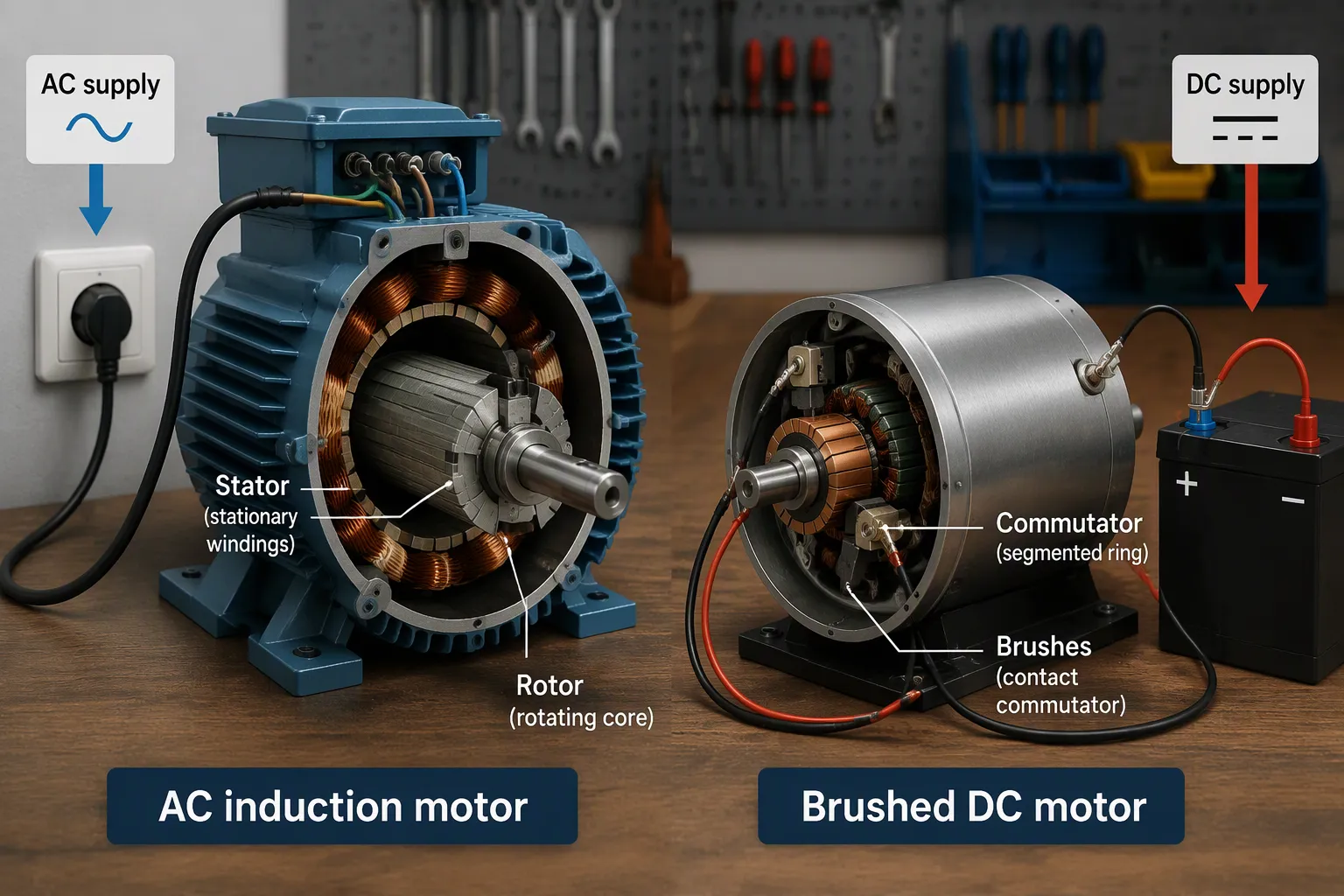
The power source is the first and clearest difference between ac and dc motor designs. An alternating current (ac) motor pulls its power from a wall outlet or the power grid. There, the current flips direction many times each second. A direct current (dc) motor instead needs a DC supply, like batteries or a rectified power supply that turns AC into DC.
This supply difference shapes how each motor is built. An AC induction motor depends on a stator and a rotor, with no brushes or commutator. A brushed DC motor uses a commutator and brushes to flip the current direction in the rotating windings. That mechanical switching adds parts that wear down over time.
Motor Type | Key Construction Components |
|---|---|
AC Induction Motor | Stator (stationary part) and rotor (rotating part) |
Brushed DC Motor | Commutator and brushes |
You will also find that AC motors power industrial and residential equipment. Examples include compressor drives, air conditioning compressors, and hydraulic and irrigation pumps. DC motors serve equipment that needs stable speed and torque, like steel mill rolling equipment and paper machines.
Speed Control and Torque
Torque and speed control show more key differences between dc and ac motors. AC motors can deliver much higher torque through single-phase or three-phase AC voltage. This makes them common in industrial and automotive applications. DC motors, by contrast, usually produce higher starting torque, even at smaller sizes. A DC series motor offers both high starting torque and adjustable speed. But it demands high maintenance and an AC-DC conversion stage.
Speed control separates the two types even further. An AC motor runs at the frequency of the AC supply. It resists speed changes when the load shifts. To adjust its speed, you need a Variable Frequency Drive (VFD). This device converts AC to DC and back to AC at a different frequency. This adds cost and brings in inefficiencies. It may also cause shaft and bearing currents that shorten motor lifespan if you do not manage them. AC motors also tend to lose torque at higher speeds.
A dc motor is far easier to control. You can adjust its speed by varying the armature voltage or using external resistors. DC motors provide torque control from zero speed without an encoder. They typically outperform AC motors in stall operations. Their speed range often reaches up to five times the rated base speed. For precise speed and torque control, DC drives offer analog voltage regulation. Still, they have less precision than digital frequency control. When you need precise speed and torque control across frequent changes, a DC motor with a drive is often the simpler path. For continuous operation at a steady pace, an AC motor with a VFD handles the job well.
AC vs DC Motors: Efficiency, Cost, and Maintenance
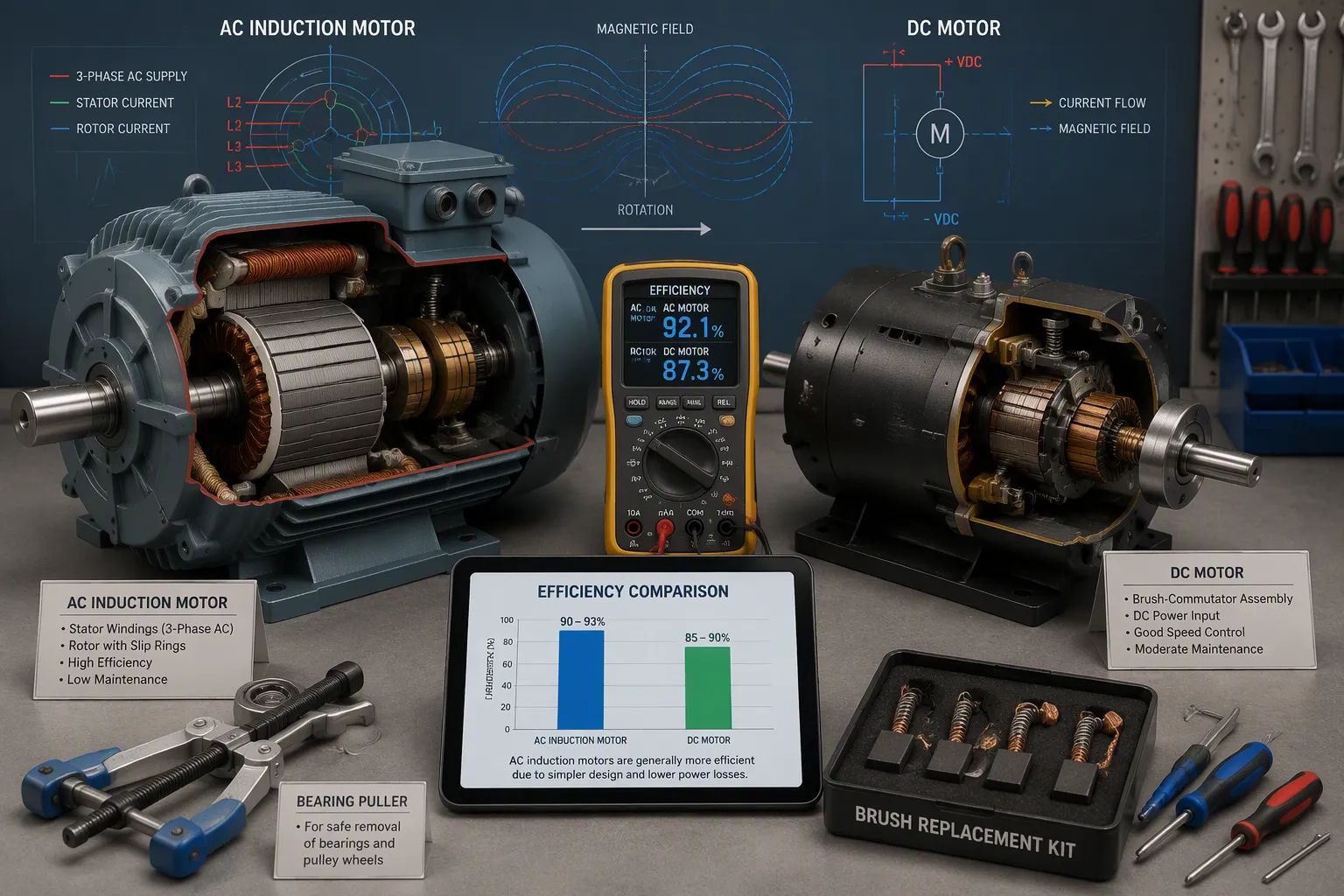
Efficiency and maintenance costs set ac and dc motors apart just as clearly as their power supplies do. When you compare the two families, you need to see where energy goes and how much upkeep each design needs.
Efficiency and Energy Loss
An alternating current motor loses efficiency because it must create its secondary magnetic field. That field drives induction current in the rotor, and slip adds even more losses. Copper (I²R) losses give off heat in the windings. Eddy currents flow in the iron core and waste energy. Hysteresis losses eat up power each time the 60 Hz field reverses. Friction and windage losses finish off the total.
DC designs skip induction-current and slip losses completely. Their losses come from electrical resistance in the copper, core effects, mechanical friction, brush-commutator friction, contact resistance, and stray load effects. Brushed dc motors waste extra energy through friction at the brush-commutator contact, which heats the motor and can cause sparking under overload.
You can spot these differences in real efficiency numbers:
Motor type | Efficiency range |
|---|---|
at least 95% in typical applications | |
Brushless DC motor with permanent magnet rotor | 88–92% |
The table shows AC induction motors often hit a higher top efficiency in large, continuous-duty machines. A direct current motor stands out in small-scale use, where its simple control of speed and torque avoids the conversion losses of an AC drive.
Cost and Maintenance Needs
Upfront price and long-term upkeep tell a different story. You can compare lifetime costs across the three main motor families:
Cost dimension | AC type | Brushed DC type | Brushless DC type |
|---|---|---|---|
Upfront cost | Lower, simple construction | Less expensive than brushless DC | More expensive than AC or brushed DC |
Maintenance | Low; no brushes to replace | High due to brush friction and wear | Better than brushed DC, but still higher-cost than AC |
Lifespan | Longer than brushed DC | Limited durability | Improved lifespan compared with brushed DC |
Lifetime total | Lower long-term cost for many high-power jobs | Higher long-term cost from maintenance and wear | Comparable to AC types |
Maintenance schedules back up these numbers. For DC motors, you should inspect brushes every 3–6 months and check them monthly in harsh places. Replace each brush when it wears down to 25% of its original length. AC motors need bearing checks every 6 months to once a year, plus regular lubrication.
A full preventive maintenance routine covers more ground. You must check and replace worn brushes, confirm brush pressure and position, and measure operating speeds. You also need to clean windings, commutators and brushes, tighten loose connections, record amperages, service sleeve-bearing oil, and run vibration analysis.
AC motors often turn out to be the most cost-effective choice for large, constant-speed jobs. Brushless DC types cost more at first due to efficiency and control complexity, but their lifetime costs stack up well against AC motors. In some setups, the lower maintenance of an AC system pays back the higher initial cost of a VFD in about 18 months.
For large power and constant-speed jobs, choose AC. For small loads where you need precise speed and torque control, brushless DC gives better value over its life.
In the end, your choice depends on what your application demands, the alternating current supply you have, and your maintenance crew.
Types of AC and DC Motors
Common AC Motor Types
AC (alternating current) motors split into two main groups: synchronous and induction motors. A synchronous motor spins at the same speed as the rotating magnetic field, so no slip happens. Large synchronous motors often reach above 95% electrical efficiency. They can run at unity power factor, which helps fix power factor in industrial plants.
Induction motors need slip to work. The rotor turns slightly slower than the stator's magnetic field, creating rotor current and torque. Single-phase AC motors serve most household applications like vacuum cleaners. Three-phase AC motors dominate industry. Squirrel-cage rotors are robust and economical, so you see them in pumps and conveyors. Wound-rotor types give high starting torque for cranes and hoists. These are the most common ac motors in industry. The key traits of ac motors are a simple build. They need a variable frequency drive if you want to adjust speed.
Common DC Motor Types
DC (direct current) motors come in brushed and brushless types. A brushed direct current (dc) motor has carbon brushes and a commutator to switch current in the rotating windings. This keeps upfront cost low, but brush wear limits life. Common dc types include shunt, series, and compound motors. Series motors give high starting torque for cranes and electric shovels. Shunt motors give stable speed for conveyors and mixers.
A brushless DC motor uses an electronic controller, not brushes. Efficiency reaches about 88–92%, and life lasts longer than 10,000 hours. Brushless motors also spin faster than 10,000 RPM and make little electrical noise. For exact speed and torque control, a brushless motor with a controller gives the best performance. The key traits of dc motors include easy speed control and strong starting torque. These dc motors often appear in robotics and car wipers. For a fixed-speed job, an alternating current (ac) motor is often the cheapest. When you compare dc and ac motors, remember that each family fits different jobs. You choose ac and dc motors based on your power supply and the speed control you need.
Choosing the Right Motor
Matching Motor to Application
Picking the right motor for the right job begins with your load. You should look at speed range, starting torque, duty cycle, and power supply. dc motors naturally make high starting torque. They handle high-inertia loads and frequent stops well. ac motors usually give lower starting torque. You can boost that with a VFD or special starting methods. Steady operation works best with induction motors. A direct current (dc) motor often fits better when you need exact speed and torque control.
Your available power matters too. An alternating current from the grid supports any ac motor type. dc motors need rectified supplies or an existing DC bus. Environmental conditions also guide the choice. ac motors resist moisture and contaminants better with sealed construction. Brushed designs need extra protection in dusty areas. Brushless designs avoid brush wear and suit medical equipment, electric vehicles, and positioning systems. These are common uses for each type of motor. You match which motor for which job by studying the torque curve and the control requirement.
Weighing Performance and Cost
Compare ac vs dc motors across total lifetime cost. ac motors usually have the lowest purchase price. They also offer long service life. Brushed designs require brush replacement every 2,000 to 5,000 operating hours. That maintenance cost adds up. Brushless designs cost more at first but can match premium AC efficiency. In HVAC fan applications, variable-speed DC systems show 92% peak efficiency versus 78% for ac induction motors. They also cut energy use by 65-70% in retrofits. However, their electronics may fail suddenly. Induction motors fail slowly and stay easy to repair.
You should also think about control complexity. An alternating current (ac) motor runs best at constant speed. Adjustable output requires a VFD, which raises cost. A dc drive gives you control of speed and torque directly through voltage. If you need exact speed and torque control across frequent changes, DC often wins. If you need tough, constant-speed power under harsh conditions, ac induction motors do the job. The final decision depends on your real duty cycle and budget.
You can now clearly see how AC and DC motor designs differ. AC motors run on alternating current from a wall outlet. DC motors need batteries or a rectified supply. Construction, speed control, efficiency, cost, and typical applications all follow from that split. The difference between AC and DC motors comes down to your needs, not to a winner. The key differences matter most when you match them to your project. Set the difference between AC and DC motors against your power source and performance goals. Then pick the motor that fits your job best.
FAQ
Which motor type is better for my project?
Neither type wins every time. You pick based on your power source and your needs. AC motors suit constant-speed, high-power jobs. DC motors fit precise speed and torque control. Match the motor to your load, duty cycle, and budget.
Which motor is easier to control speed on?
You can adjust a dc motor's speed by changing armature voltage or using resistors. An AC motor needs a Variable Frequency Drive for speed changes. That device adds cost and can cause bearing currents. For frequent speed changes, DC control is simpler.
Which motor costs less to maintain?
AC motors need bearing checks every 6 to 12 months. Brushed dc motors need brush inspections every 3 to 6 months and brush replacement at 25% wear. Brushless DC types last longer than 10,000 hours. AC motors usually cost less over their lifetime.
Can I run a DC motor on AC power?
A DC series motor can run on AC power. A shunt motor cannot. Most dc motors need batteries or a rectified supply that converts AC to DC. Check your motor type before you connect it to any power source.


