


What it costs to replace an AC motor in 2026
Views: 0 Author: Site Editor Publish Time: 2026-09-03 Origin: Site


In 2026, you will probably pay $450 to $2,000 to replace an AC motor in your home. A single-speed PSC HVAC blower motor usually costs $300 to $900 installed. A variable-speed ECM motor can reach $2,000. The national average for a standard home job is about $560. Emergency after-hours service adds $75 to $150. Labor matters too: you might pay $80 to $400, depending on how easily the motor sits.
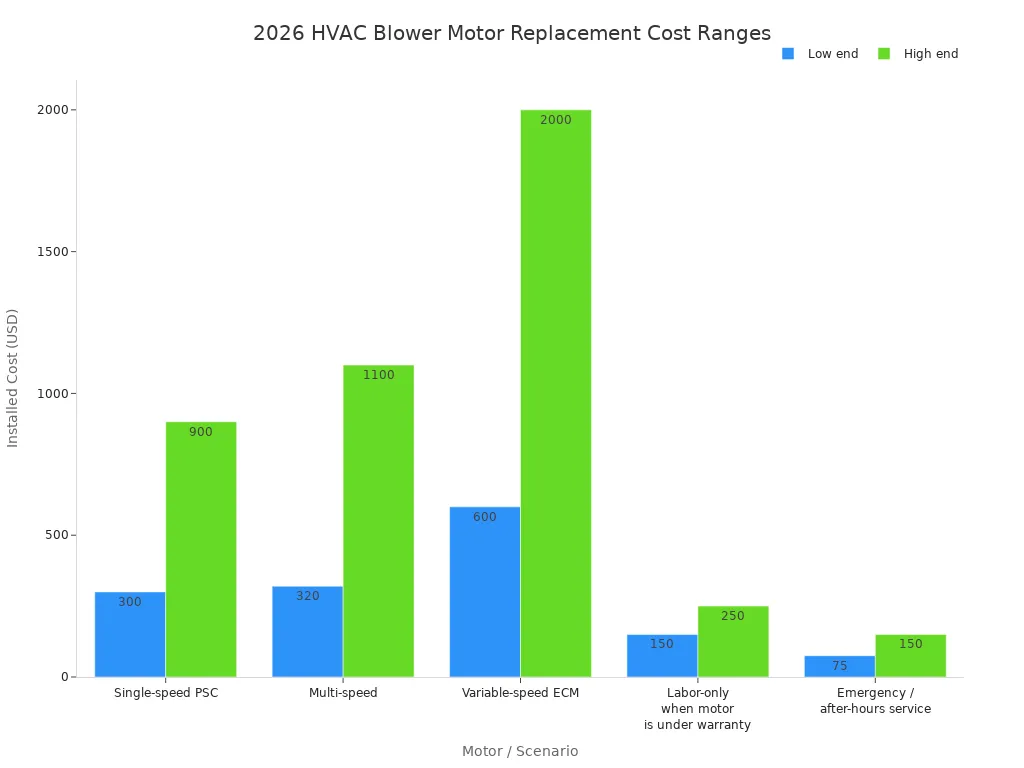
Remember, “AC motor” can mean an indoor blower motor or an outdoor condenser fan motor. Motor type and location will decide your final invoice. So should you replace this motor, and what will it actually cost?
Key Takeaways
Expect to pay $450 to $2,000 to replace an AC motor in 2026. Most homeowners spend around $560.
Motor type matters: PSC motors are cheaper, while ECM motors save energy but cost more upfront.
Always get more than one written price estimate. Also check your warranty before you pay for a new one.
Replacing an AC motor yourself is dangerous because of electrical hazards. Hire a professional unless you have experience.
If your system is old, compare repair costs with a full replacement to decide what is best.
HVAC Blower Motor Replacement Cost 2026
How Much Does It Cost to Replace an HVAC Blower Motor?
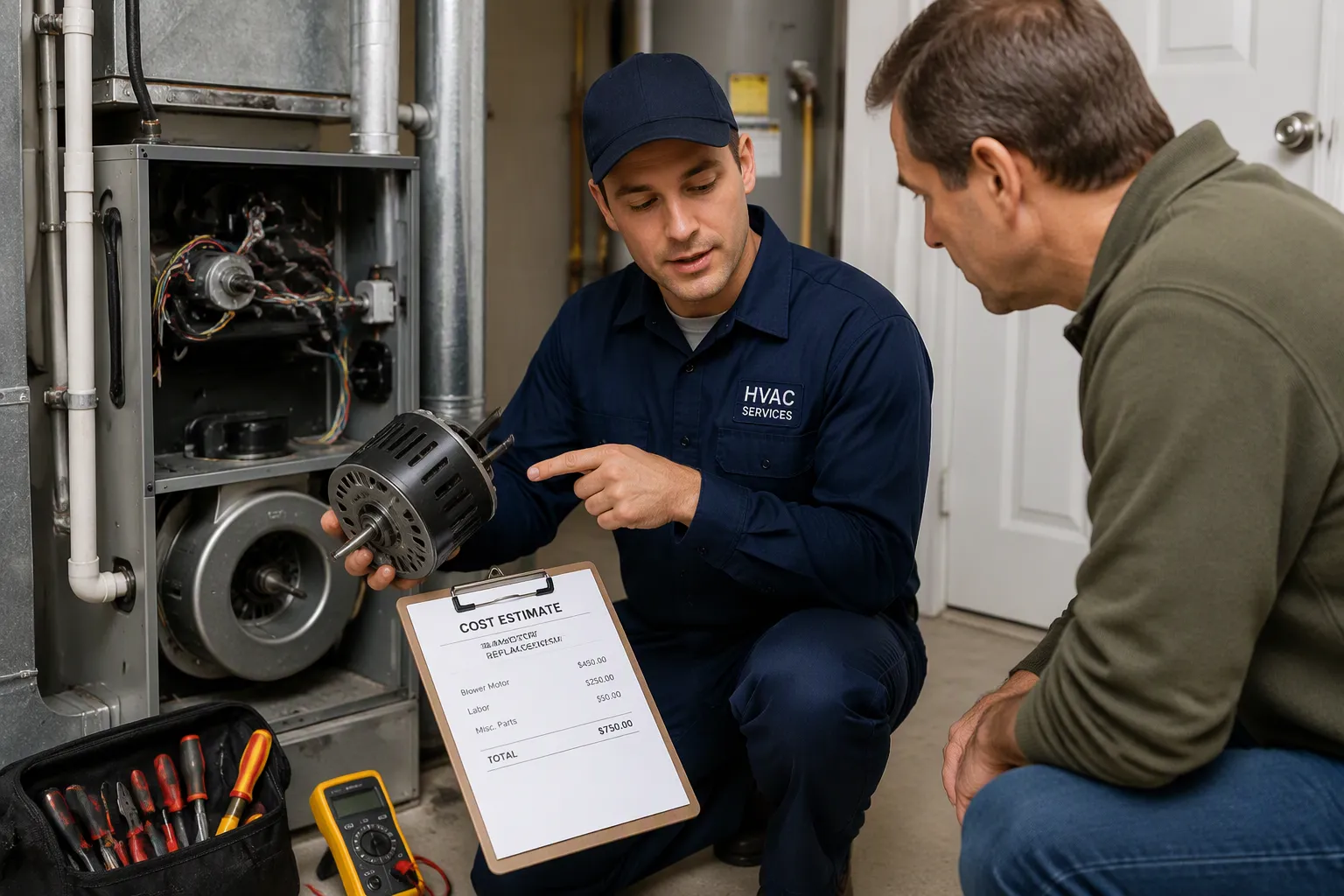
You will pay $450 to $2,000 installed for an HVAC blower motor, depending on the motor type and the contractor you hire. That is your typical all-in cost, and it covers the part, the labor, and the diagnostic visit in most cases. The national average for blower motor replacement sits near $560, so a quote far above that number deserves a second look.
How much does it cost to replace an HVAC blower motor in a single-family home? For a standard swap, total blower motor replacement cost runs $600 to $1,000, which includes 1 to 3 hours of labor at $75 to $125 per hour. A homeowner in New Jersey was recently quoted $1,200 for a blower motor replacement, a figure that lands in the middle of the 2026 price ranges once you factor in access and part availability.
Related motors follow similar logic. Outdoor condenser fan motor repairs in many markets run $450 to $1,200 or more. The fan motor part alone costs $100 to $400, and labor adds $150 to $300. Vehicle blower motor replacement averages $300 to $650, though the bill can climb past $900 when the motor sits deep under the dashboard. Here is the blower motor replacement cost at a glance:
Motor type | Typical planning range |
|---|---|
Outdoor condenser fan motor | $450–$1,200+ |
Indoor PSC blower motor | $600–$1,300+ |
Indoor ECM / variable-speed blower motor | $900–$1,800+ |
PSC vs. ECM Blower Motor Replacement Cost
Motor type drives the biggest swing in your invoice. A PSC single-speed blower motor costs $350 to $700 with labor, or $450 to $900 installed in many markets. A variable-speed ECM blower motor with an OEM part runs $1,000 to $2,000 or more. Entry-level ECM units land at $350 to $900 total, mid-range models at $700 to $1,400, and premium ECM blower motors at $1,200 to $2,500 or more.
Brand matters too. Trane and American Standard blower motors range from $180 to $2,000, Carrier from $100 to $1,600, Goodman and Amana from $100 to $1,200, Rheem from $130 to $1,300, and York from $130 to $1,800.
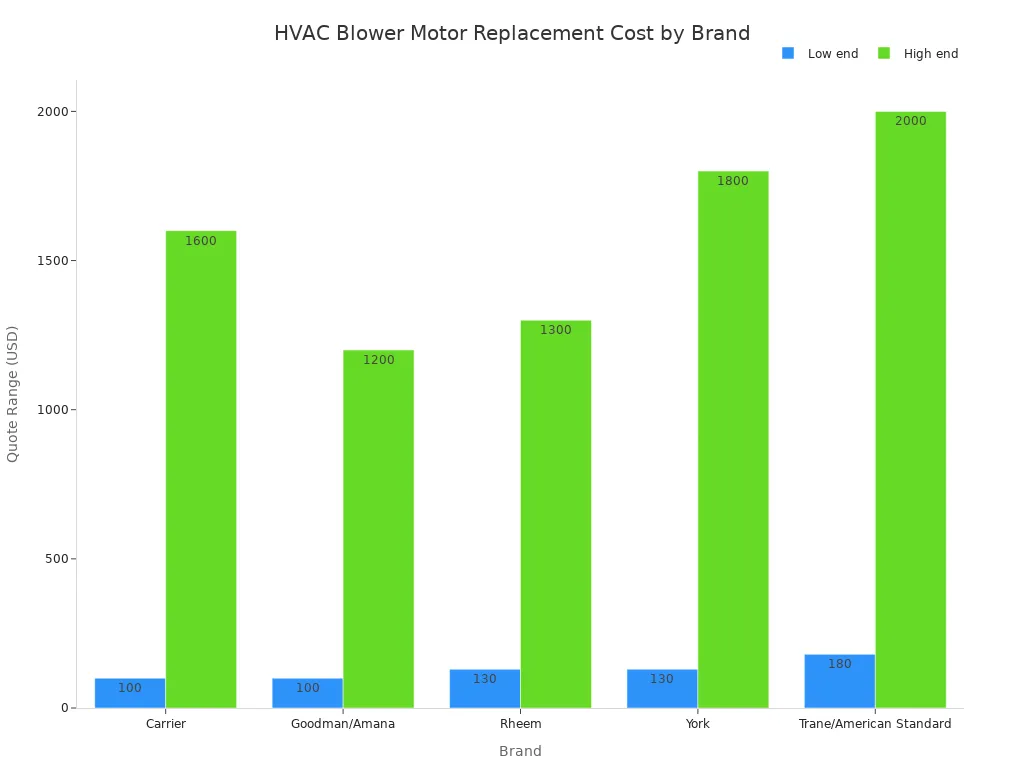
So when you compare blower motor replacement costs, remember that the ECM blower motor saves energy over time but costs more up front. If you replace a blower motor on a tight budget, a PSC unit keeps the cost range low. If you plan to stay in the home for years, the ECM upgrade often pays for itself.
What Affects the Price to Replace an AC Motor?
Motor type comes first. An ECM motor costs more than a PSC motor, and that one choice can double what you pay. After that, labor rates, local demand, and how hard the motor is to reach all change the final price.
Labor, Location, and Access Costs
Where you live changes what you pay for labor. The national hourly range for HVAC work is $75 to $150 per hour in 2026. High-cost metro areas charge more because overhead and living costs are higher. Rural areas charge less for the same reason. Phoenix is a clear example: an emergency summer diagnostic call there costs $250 to $350, which is 30% to 50% above the national average. Service call fees across the country are $70 to $200, and nights, weekends, emergencies, or long-distance travel push that fee up.
Region / Factor | HVAC Labor Rate Detail (2026) |
|---|---|
National hourly range | $75–$150 per hour |
High-cost metro areas | Higher rates than rural areas |
Rural areas | Lower rates due to reduced overhead |
Phoenix (example) | $250–$350 for emergency summer diagnostic call |
Service call fees (national) | $70–$200 |
Access matters just as much. A blower motor hidden behind a tight panel takes longer to swap than one with clear space around it. That extra time shows up on your bill. Jobs that need more labor vary more by region than jobs that need more parts, so a capacitor swap costs about the same everywhere while a full motor replacement does not.
Additional Parts That Raise the Total
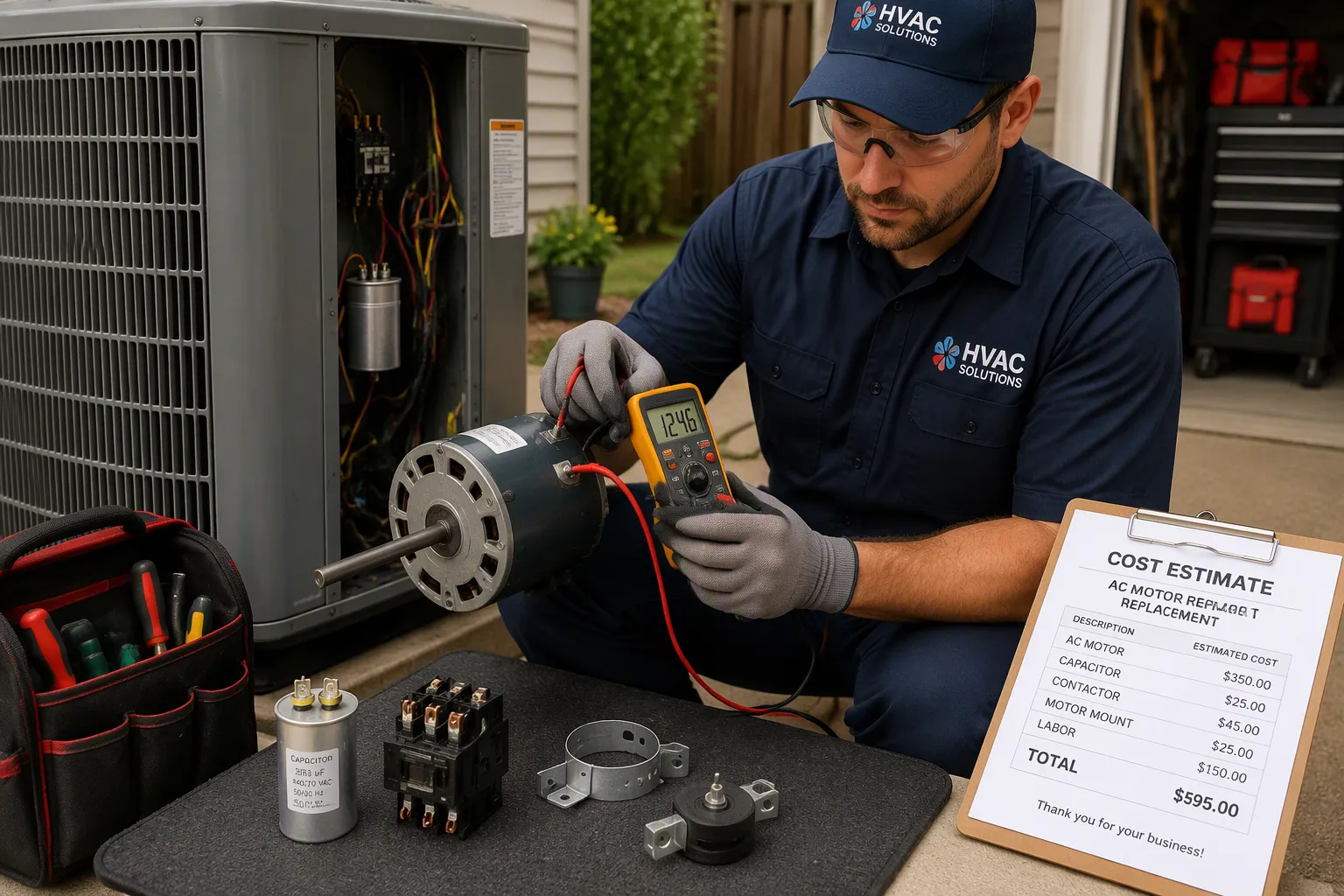
The motor itself is rarely the whole bill. Capacitors, motor mounts, contactors, and electrical repairs all add to the total cost breakdown. A capacitor replacement costs $120 to $250 in 2026. Contractors group contactor replacement with capacitor work as a simple electrical component repair, so you may not see it priced on its own. A common AC repair overall costs $150 to $600, with a national average near $350.
Replacing a simple electrical component like a capacitor or contactor is relatively inexpensive. Repairs involving refrigerant, coils, or the compressor require more labor, specialized tools, and expensive materials.
Older systems often need small duct or wiring fixes before the new motor can go in. Those fixes protect the new part and prevent a repeat failure. If your technician finds a failing compressor, though, the bill jumps to $2,500 to $2,800 or more. At that point, you are weighing a major component repair against a new system.
So when you replace an AC motor, ask for a written breakdown of parts, labor and what drives the price. That breakdown shows you what drives the cost and helps you spot padding. It also lets you compare bids fairly, since one contractor may bundle a capacitor while another lists it separately. Understanding these line items puts you in control of the replacement cost, whether you are dealing with ac fan motor issues or indoor blower motors.
Signs Your AC Motor Needs Replacement
Common Symptoms of a Failing Motor
Your system often gives you hints before a motor stops working. Weak or no airflow from your vents is the most common sign. The motor has a hard time spinning the blower wheel. This can happen because of a bad capacitor, worn bearings, or a dirty squirrel cage. Strange noises come next. Grinding, squealing, rattling, or humming means bearing wear, debris in the fan blades, or the blower wheel hitting its housing. A burning smell from your vents is an emergency. Shut the system down and call for help right away.
Watch for these warning signs and act fast:
Warning Sign | Urgency Level | Recommended Action |
|---|---|---|
Weak or no airflow from vents | Moderate | Schedule service within a week |
Strange noises (grinding, squealing, rattling, humming) | Moderate to High | Call for inspection within 2 to 3 days |
Burning smell from vents | Emergency | Shut down system immediately, call now |
Sudden increase in energy bills | Low to Moderate | Schedule efficiency evaluation |
Frequent system cycling | High | Professional diagnosis needed soon |
Overheating and system shutdowns | Emergency | Emergency service required |
Inconsistent temperature control | Moderate | Airflow assessment recommended |
A motor that works poorly uses more electricity. This can raise your monthly cooling costs. A struggling motor also cannot push air evenly. So some rooms stay hot while others feel cold.
Outdoor units show their own clues. You might hear humming from the condenser while the fan blade sits still. Grinding or squealing from the top of the unit points to failing bearings inside the ac fan motor. Warm air may blow from your indoor vents even with the thermostat set correctly. Your system might also cool fine in the morning and quit on hot afternoons. Frequent breaker trips and short cycling round out the list.
Check the Capacitor and Compressor First
A bad capacitor can act like a dead motor. The motor hums but will not spin, and you think the worst. Before you pay for a replacement, ask your technician to test the capacitor. That simple check costs far less than a new motor. A failed capacitor is one of the most common reasons an ac fan motor stops turning.
Your compressor deserves a look too. If the compressor is failing, a new motor will not fix your cooling problem. A technician can confirm whether the motor is the real culprit. That diagnosis protects your wallet before you approve any replacement.
Should You Replace an AC Motor Yourself?
Replacing an AC motor means working around live electrical parts. A capacitor can still hold a dangerous charge after you shut off the power. One wrong move can hurt you badly. Condenser fan motors bring refrigerant-side dangers too. Breathing in refrigerant can cause serious breathing problems. Experts warn against DIY AC motor replacement for this reason. Saving money is not worth the risk of injury or death.
When DIY AC Motor Replacement Makes Sense
You can replace an AC motor yourself only if you have the right tools and real electrical experience. You need an insulated screwdriver to safely discharge the capacitor. Take clear photos of all wiring before you disconnect anything. Label every wire so you avoid confusion later. Basic hand tools will loosen the mounting screws and the set screw on the blower wheel. You also need a multimeter to confirm zero voltage at the contactor terminals.
Before you touch anything, set the thermostat to "Off." Shut off the circuit breaker for the outdoor unit. Check that the contactor terminals read zero volts. Discharge the capacitor with an insulated screwdriver across both terminals. Wear safety goggles and heavy-duty electrical gloves. Modern furnaces with ECM motors have complex controls. These need specialized diagnostic tools and expertise. If you feel unsure at any step, call a professional.
When to Replace the Whole AC System Instead
Sometimes a fan motor replacement is not the smart move. Compare the motor replacement cost against a full system replacement. In 2026, a new central AC system costs $3,000 to $15,000 installed, with a national median of $9,000. If one repair costs 25% to 50% of a new system, replacement is usually the better investment. Around 25 years, an AC is past its useful life.
The same logic applies to any major component. A compressor failure in a system over 10 years old often justifies full replacement. One homeowner spent $2,500 on a compressor in a 14-year-old system. The evaporator coil failed soon after. The same risk applies when you replace an AC motor on an old system. Other parts may fail next. Weigh the repair cost against long-term reliability before you decide.
Warranty and Savings for AC Motor Replacement
Check Your Warranty Before You Pay
Your manufacturer warranty might cover the motor part. Blower motors and fan motors are covered if a defect caused the part to fail. Basic parts coverage usually lasts 5 years. Register the system within 60 days of install, and that term often extends to 10 years. Trane, Carrier, and Lennox all use this rule. Goodman goes further: select models get a lifetime compressor warranty.
Here is what most manufacturer warranties exclude:
Labor costs are excluded, even if the part is covered
Refrigerant and recharges are excluded
You pay diagnostic and service call fees
Ductwork and routine maintenance items are not included
Damage from improper installation, neglect, storms, or pests is not covered
Registration matters more than many homeowners think. Miss the deadline, and you drop to the shorter base term. DIY repairs, non-OEM parts, and unlicensed installation can void coverage completely. A home warranty might pick up the labor your manufacturer warranty skips. Check that policy too. Some labor warranties from your installing contractor cover the work for a set time.
Get Multiple Bids and Lower the Final Invoice
Ask at least two contractors for written bids before you choose. Each bid should show parts, labor, warranty terms, and disposal on separate lines. That list lets you compare one bid to another fairly. Ask if the quote uses an OEM motor or an aftermarket motor. OEM parts protect your warranty. Aftermarket motors cost less at first, but they may void coverage.
Bundle small repairs while the technician already has the system open. A capacitor swap adds very little to the bill when done with a motor change. Spring or fall scheduling helps too. Off-season demand drops, and some contractors share those savings with you. Every dollar you save here lowers your total cost. A few phone calls and one well-timed visit can cut hundreds off your final price. That is real money saved.
In 2026, replacing an hvac blower motor usually costs $450 to $2,000 installed. PSC motors cost less. ECM motors cost more. Get two or three written quotes for your blower motor replacement. Ask what each price covers: parts, labor, warranty, and disposal.
Find out your motor type first. Then look at your warranty coverage. Last, compare the hvac blower motor replacement cost to a full AC replacement. That comparison shows you whether to repair or replace. You now have the numbers to make a confident choice.
FAQ
How much should I expect to pay for an AC motor replacement in 2026?
You will pay $450 to $2,000 installed for an HVAC blower motor. PSC motors land at $300 to $900. ECM motors can hit $2,000. Condenser fan motors run $450 to $1,200 or more. The national average sits near $560, so treat a much higher quote with suspicion.
Can a bad capacitor look like a dead motor?
Yes, and this mix-up costs you money. A failed capacitor makes the motor hum without spinning, which mimics motor failure. Ask your technician to test the capacitor first. That check costs far less than a new motor, and it often solves the problem outright.
Is replacing an AC motor a good DIY project?
Only if you have real electrical experience and the right tools. Capacitors hold a dangerous charge after shutdown. Condenser fan motors add refrigerant hazards. ECM motors need specialized diagnostic tools. If you feel unsure at any step, hire a professional instead.
Should I repair the motor or replace the whole system?
Compare the repair quote against a new system. A full AC replacement costs $3,000 to $15,000 in 2026, with a median near $9,000. If the repair hits 25% to 50% of that number, replacement usually wins. Systems around 25 years old are past their useful life.
Does my warranty cover a new blower motor?
It might cover the part, not the labor. Basic parts coverage lasts 5 years. Register your system within 60 days and that term often extends to 10 years. Labor, refrigerant, and diagnostic fees usually stay your responsibility. Check your home warranty too, since it may pick up the labor.


